We talk about decisions as if they happen at a single point in time. You stand at the fork, weigh A against B, pick one, and live with whatever follows.
They don’t work that way. Every decision is one point on a continuum of decisions, a marker along the road rather than the road itself.
The Fork
Treat a choice as a fixed point and two things go wrong. Before it, you stall: if A or B settles everything, every unknown has to be resolved first, and the unknowns never all resolve. After it, you feel locked onto rails. The choice laid the track and all that’s left is to ride it out, so you stop steering just as reality starts giving you better information.
Chess players don’t think this way, and neither should you. A strong player who blunders on move 12 doesn’t spend move 13 regretting it, because the board doesn’t care how it got there. The only question is what the best move is now. I wrote more about that in Slanting the Board.
Measuring Up
Every decision is also a prediction. Launch the feature and you’re predicting customers will use it; hire someone and you’re predicting they’ll create more value than they cost. Once you choose, reality starts grading that prediction, and the gap between what you expected and what you see is information you could not have had before deciding. The next decision runs on it.
Push harder, add help, cut scope, change the price, wait another month. None of these undo the first choice, but each one slants the board a little further toward the outcome you want, and you get to make as many as you like. Speed helps here: when you can fix mistakes as quickly as you make them, being wrong early is cheap.
Two-Way Doors
Jeff Bezos sorts decisions into two kinds in his 2015 letter to Amazon shareholders. One-way doors are “consequential and irreversible or nearly irreversible” and deserve slow deliberation. Two-way doors deserve speed because “you can reopen the door and go back through.”
That framing treats decisions as either reversible or irreversible, and imagines the fix is going back. Most of the time nobody goes back through the door. You keep walking and decide again from where you now stand, and a one-way door only closes the way behind you. Whether a door swings one way or two matters less than the fact that you’re still making decisions after walking through it. Outcomes are rarely decided by one choice, and mostly by how the next ones respond to the information it creates.
Markers
A past decision is a marker on the road you’ve travelled. It tells you where you were and what you knew when you passed it. It doesn’t tell you where to go next.
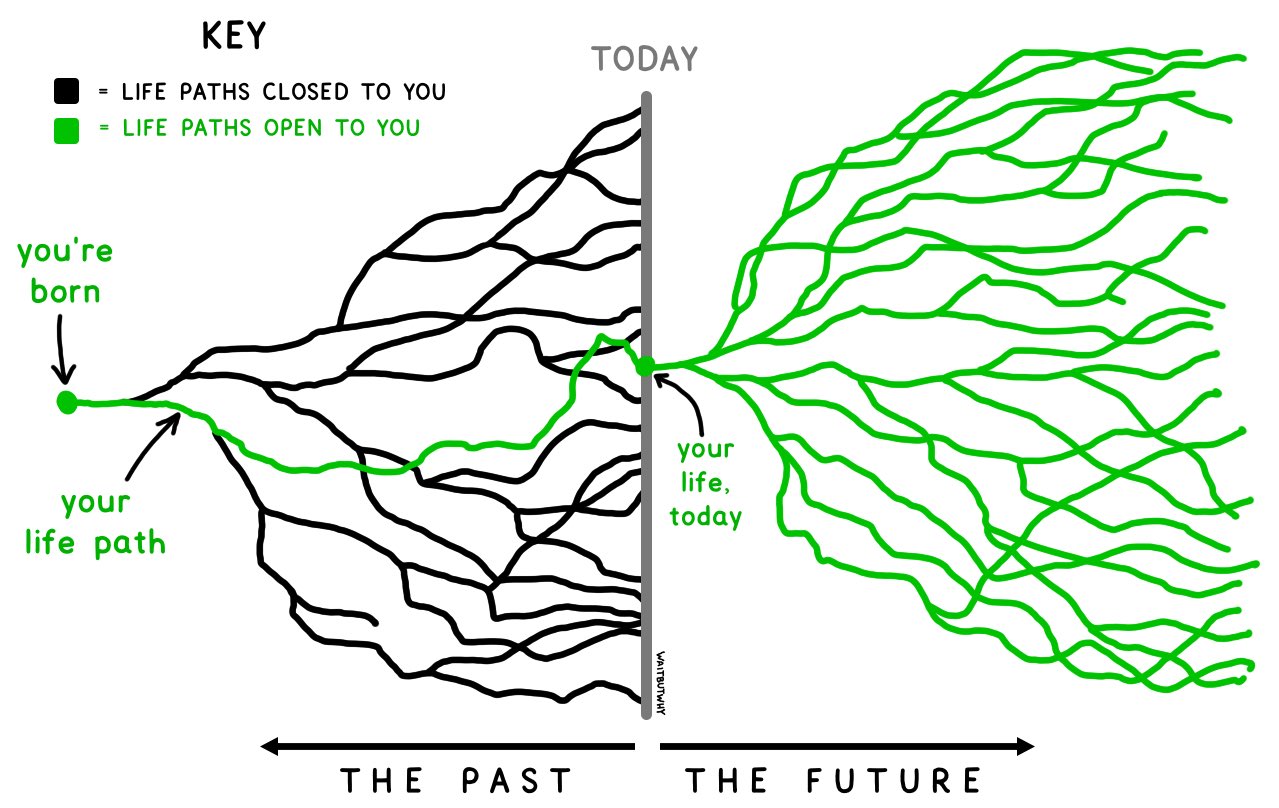
Behind you is a road. Ahead is always an open field.